$26
Median asking price
$25–$30
Middle half of prices
8
Listings seen
1
In stock now
1.9 h
Median time to sell (1 timed)
How rare is it?
Common in trade (early)
In the wild: Cross. A cross of N. ampullaria (least concern), N. aristolochioides (critically endangered). Crosses in trade are almost always nursery-made, so buying one takes nothing from the wild.
For collectors: Common in trade. 8 listings at 4 shops in 12 days; 1 in stock now; typically sells in 1.9 h. Early estimate: under a month of history.
Buy now
Cheapest first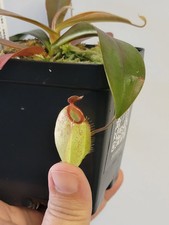
See what this plant actually sells for. Fair prices, every recorded sale and price trends are free for collectors.
Price history
listed or restocked sold out (price it sold at)
By shop
Asking prices, and what sold| Shop | Listings | In stock | Sold | Sold median | Asking median | Low | High |
|---|---|---|---|---|---|---|---|
| eBay | 2 | 1 | $25 | $25 | $25 | ||
| Florae Collaborative | 2 | $26 | $26 | $27 | |||
| Carnivero | 2 | $27 | $25 | $30 | |||
| Predatory Plants | 2 | $38 | $35 | $41 |
By breeder
Whose line it is, from codes like BE-, AW-, JH- and BCP in listing titles| Breeder | Listings | In stock | Sold | Sold median | Asking median | Codes |
|---|---|---|---|---|---|---|
| Borneo Exotics | 2 | 1 | $27 | $26 | BE-3658 | |
| no breeder given | 6 | 1 | $27 |
Medians need a few sales each before they say much about a breeder premium; codes link to every listing of that line across shops.
Clones & forms
Grower codes, clone letters and named forms seen in listing titles| Clone / form | Listings | In stock | Median | Shops |
|---|---|---|---|---|
| BE-3658 | 2 | $26 | Florae Collaborative |
What the nurseries call it: Intermediate (Carnivero, Predatory Plants)
Growing conditions
Intermediate Nepenthes by day by night a typical home the coldest it takes
Good houseplant Grows in an ordinary home with a bright window or a grow light.
- bright window or grow light
- most adapt to household humidity once acclimated; pitchering improves above 50%
- hybrids are usually more forgiving of household conditions than either parent
A cross of lowland and highland parents; hybrids usually take conditions between their parents'.
| Day | 75–88°F (24–31°C) |
| Night | 57–68°F (14–20°C) |
| Never below | 50°F (10°C) |
| Humidity | 60–90% |
| Light | Bright indirect light or partial sun |
| Water | Mineral-free only (rain, distilled, RO; TDS under ~100 ppm, ideally much lower); damp, not waterlogged; no tray. |
| Media | Long-fibre sphagnum + perlite, optional orchid bark |
| Dormancy | none |
Tom's species pages: N. peltata (865-1635 m) 24-31C days / 14-21C nights; N. glandulifera (1100-1700 m) 24-30C / 14-20C. Most tolerant group; many hybrids grow here.
Likely best temperatures. Estimated for the cross from its parents' habitats, averaged as if from about 900–2,300 m: days 21–31 °C (70–88 °F), nights 11–21 °C (52–70 °F). Night temperatures in an ordinary home are close to its habitat.
Worked out the way Tom's Carnivores' Nepenthes calculator does it: the average of the parents' ranges, each parent passing on half. An estimate: parentage, clone and how a plant was raised all matter, and plants often grow well outside it.
Nepenthes ampullaria: 0–2,100 m · Borneo, Sumatra, Peninsular Malaysia, Singapore, Thailand, Maluku, New Guinea and minor islands · IUCN LC · source
Nepenthes aristolochioides: 1,800–2,500 m · Indonesia (Sumatra, Jambi: Mt Tujuh) · IUCN CR · source · Tom's profile