$157
Median asking price
$150–$164
Middle half of prices
4
Listings seen
1
In stock now
3.0 days
Median time to sell (1 timed)
How rare is it?
Uncommon in trade (early)
In the wild: Cross. A cross of N. lowii (vulnerable), N. truncata (endangered), N. edwardsiana (vulnerable). Crosses in trade are almost always nursery-made, so buying one takes nothing from the wild.
For collectors: Uncommon in trade. 4 listings at 2 shops in 12 days; 1 in stock now; typically sells in 3.0 days. Early estimate: under a month of history.
Buy now
Cheapest first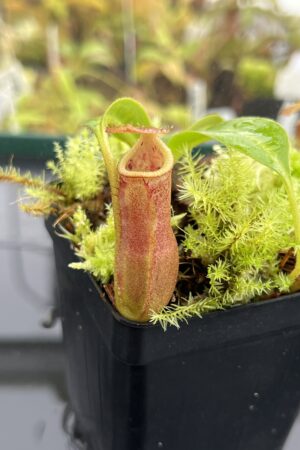
See what this plant actually sells for. Fair prices, every recorded sale and price trends are free for collectors.
Price history
Needs more history.
By shop
Asking prices, and what sold| Shop | Listings | In stock | Sold | Sold median | Asking median | Low | High |
|---|---|---|---|---|---|---|---|
| Jeremiah's Plants | 2 | $118 | $85 | $150 | |||
| Florae Collaborative | 2 | 1 | $184 | $164 | $204 |
By breeder
Whose line it is, from codes like BE-, AW-, JH- and BCP in listing titles| Breeder | Listings | In stock | Sold | Sold median | Asking median | Codes |
|---|---|---|---|---|---|---|
| Andreas Wistuba | 2 | 1 | $184 | |||
| no breeder given | 2 | $118 |
Medians need a few sales each before they say much about a breeder premium; codes link to every listing of that line across shops.
What the nurseries call it: Highland (Jeremiah's Plants)
Growing conditions
Highland Nepenthes by day by night a typical home the coldest it takes
Good houseplant Grows in an ordinary home with a bright window or a grow light.A cross of highland and intermediate parents; hybrids usually take conditions between their parents'.
What it needs in your home
Aim for: A bright windowsill or a grow light on a shelf.
- 🌙Nights 50–66°F, close to an ordinary home. A few degrees' drop at night helps it pitcher.
- ☀️Days 68–84°F: normal room temperatures are fine.
- ❄️Coldest it takes 40°F. Keep it away from cold windows and doors in winter.
- 💧Humidity 60–90%, more than most homes (30–50%). A terrarium, a grow tent with a humidifier, or a cabinet; or group plants on a pebble tray. Many hybrids adapt to 50% once settled.
- 💡Light Bright indirect light; good airflow
- 🚰Water and soil Mineral-free only (rain, distilled, RO; TDS under ~100 ppm, ideally much lower); damp, not waterlogged; no tray. Pot it in long-fibre sphagnum + perlite, optional orchid bark.
Good to know: hybrids are usually more forgiving of household conditions than either parent.
| Day | 70–82°F (21–28°C) |
| Night | 50–60°F (10–16°C) |
| Never below | 40°F (4°C) |
| Humidity | 60–90% |
| Light | Bright indirect light; good airflow |
| Water | Mineral-free only (rain, distilled, RO; TDS under ~100 ppm, ideally much lower); damp, not waterlogged; no tray. |
| Media | Long-fibre sphagnum + perlite, optional orchid bark |
| Dormancy | none (needs a nightly drop of 10-20F year-round) |
Tom's: ~20-25C days / 10-15C nights, RH at least 50% by day and higher at night. California Carnivores: 70s-80s F days, 50-60s F nights, never below 40F or above 90F. NECPS allows nights down to the 40s F. Highland plants kept warm at night slowly decline.
Likely best temperatures. Estimated for the cross from its parents' habitats, averaged as if from about 1,212–2,375 m: days 20–29 °C (68–84 °F), nights 10–19 °C (50–66 °F). A night-time drop of a few degrees helps; a cooler room at night suits it.
Worked out the way Tom's Carnivores' Nepenthes calculator does it: the average of the parents' ranges, each parent passing on half. An estimate: parentage, clone and how a plant was raised all matter, and plants often grow well outside it.
Nepenthes lowii: 1,650–2,600 m · Borneo (Sabah, Sarawak, Brunei, Kalimantan) · IUCN VU · source · Tom's profile
Nepenthes truncata: 0–1,500 m · Philippines (Mindanao, Dinagat, Leyte) · IUCN EN · source
Nepenthes edwardsiana: 1,600–2,700 m · Malaysia (Sabah, Borneo: Mt Kinabalu and Mt Tambuyukon) · IUCN VU · source · Tom's profile